

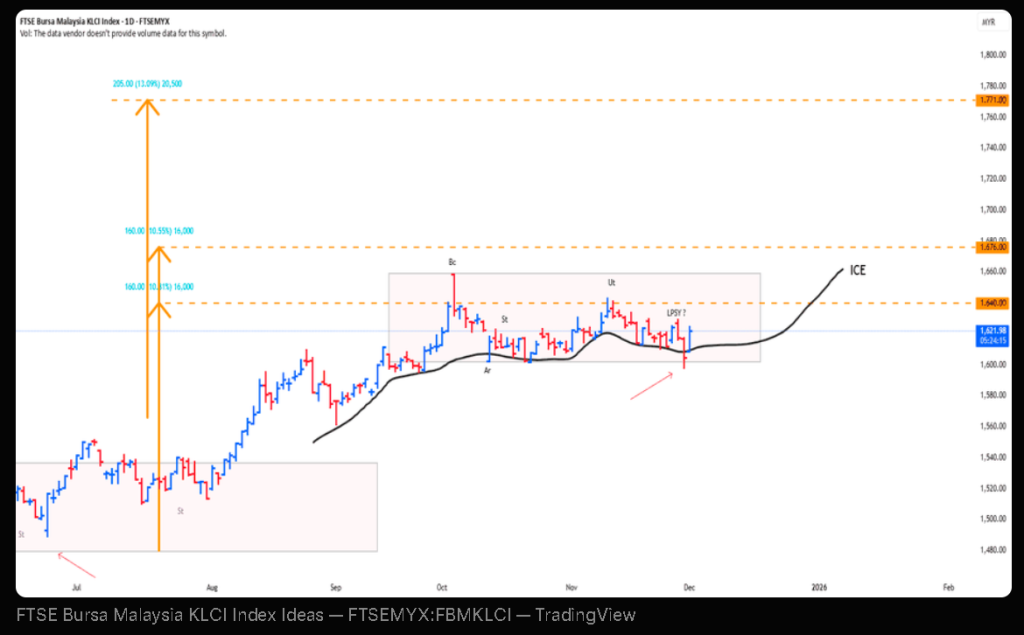
As of January 13, 2026, the FTSE Bursa Malaysia KLCI (FBM KLCI) has reached a significant milestone, closing at 1,708.20 points, up 12.76 points or 0.75% from the previous close. This marks the index’s highest level since February 2019, driven primarily by strong performances in banking and plantation sectors. The rally reflects improved investor sentiment, supported by regional market gains and domestic economic reforms. Throughout the day, the index opened at 1,700.74, hit an intraday high of 1,708.20, and saw robust trading volume with about 3.45 billion shares valued at RM3.55 billion changing hands. Earlier in the morning, it hovered around 1,702.78 at mid-morning, showcasing steady upward momentum.
Key Movers and Shakers in the Market
The banking sector led the charge, with heavyweight stocks pushing the index past the 1,700 psychological barrier. Notable gainers included:
- Maybank: Up 12 sen to RM11.06, contributing significantly to the index’s rise.
- CIMB: Gained 6 sen to RM8.27.
- Public Bank: Rose 4 sen to RM4.63.
- RHB Bank: Advanced 13 sen to RM8.03.
- Hong Leong Bank: Increased 10 sen to RM20.18.
Other top performers included Tenaga Nasional, up 10 sen to RM13.70, and plantation counters like United Plantations (up 6.7% in recent sessions) and Kuala Lumpur Kepong (up 0.8%). On the flip side, decliners such as Nestle (down 20 sen to RM119.80) and Petronas Gas (down 16 sen to RM18.26) tempered some gains. These movements highlight a shift toward blue-chip financials and commodities, buoyed by foreign fund inflows and positive regional cues.
In the broader market, active stocks like MMAG (up half-a-sen to 6.5 sen) and Semico (up 22 sen to 47 sen) saw high volume, while Ingenieur and VS Industry dipped slightly. Bursa Malaysia also launched its first quality factor indexes—the Bursa Malaysia Quality 50 Index (BMQ) and Bursa Malaysia Quality 50 Shariah Index (BMQ-S)—focusing on 50 companies with strong financial characteristics outside the main KLCI constituents.
Impact of Malaysian Policy Changes
Malaysia’s economic policies are set to bolster market confidence in 2026. The government has declared 2026 as the “Year of Execution” to accelerate growth through the 13th Malaysia Plan (13MP), emphasizing reforms in governance, digitalization, and AI adoption. Key initiatives include:
- Early disbursement of cash aid starting January 9 to boost consumption.
- A one-year penalty-free transition for e-invoicing and reduced service tax on rentals for SMEs, potentially saving businesses RM500 million annually.
- Salary adjustments for civil servants under the Public Service Remuneration System (SSPA).
- A carbon tax on high-emitting sectors like iron, steel, and energy, alongside higher excise duties on alcohol and tobacco.
Economists forecast GDP growth at 4.3%-4.5%, supported by resilient domestic demand, AI-driven investments, and tourism via Visit Malaysia 2026 (VM2026). Inflation remains low at 1.6%, with the ringgit strengthening to around 3.93 against the USD by mid-2026. These measures aim to address cost-of-living pressures and enhance competitiveness, with a fiscal deficit target of 3.5% of GDP.
Global Policies and Their Ripple Effects on KLCI
On the global front, U.S. tariff policies under the Trump administration pose both risks and opportunities. Malaysia has secured exemptions on key exports like semiconductors (over 60% insulated), through Agreements on Reciprocal Trade (ART) signed during Trump’s visit in October 2025. This reduces vulnerability to trade frictions, particularly in electronics and solar sectors, and could drive further FDI into data centers and tech.
However, broader geopolitical tensions, including U.S.-China trade dynamics and potential reciprocal tariffs, may temper export growth. Positive offsets include U.S. Federal Reserve rate cuts facilitating monetary easing in Asia, and Malaysia’s integration into global AI supply chains. Analysts maintain a KLCI target of 1,750 for 2026, citing undemanding valuations and a strengthening ringgit.
Other News Impacting the Malaysian Market
- Palm Oil Sector Boost: Exports rose 8.5%, with inventories climbing despite lower output, supporting plantation stocks.
- Labor Market Strength: Unemployment at 3%, with hiring drives expected to sustain consumption.
- Regional Trade Developments: Improved ASEAN ties and lower oil prices as a net importer benefit Malaysia’s trade surplus.
- Budget 2026 Focus: RM470 billion in spending, emphasizing halal supply chains, Islamic finance, and green transitions.
Overall, the KLCI’s performance signals a resilient start to 2026, with domestic reforms and strategic global positioning mitigating external risks. Investors should monitor upcoming Q4 GDP data and U.S.-China developments for further cues.