
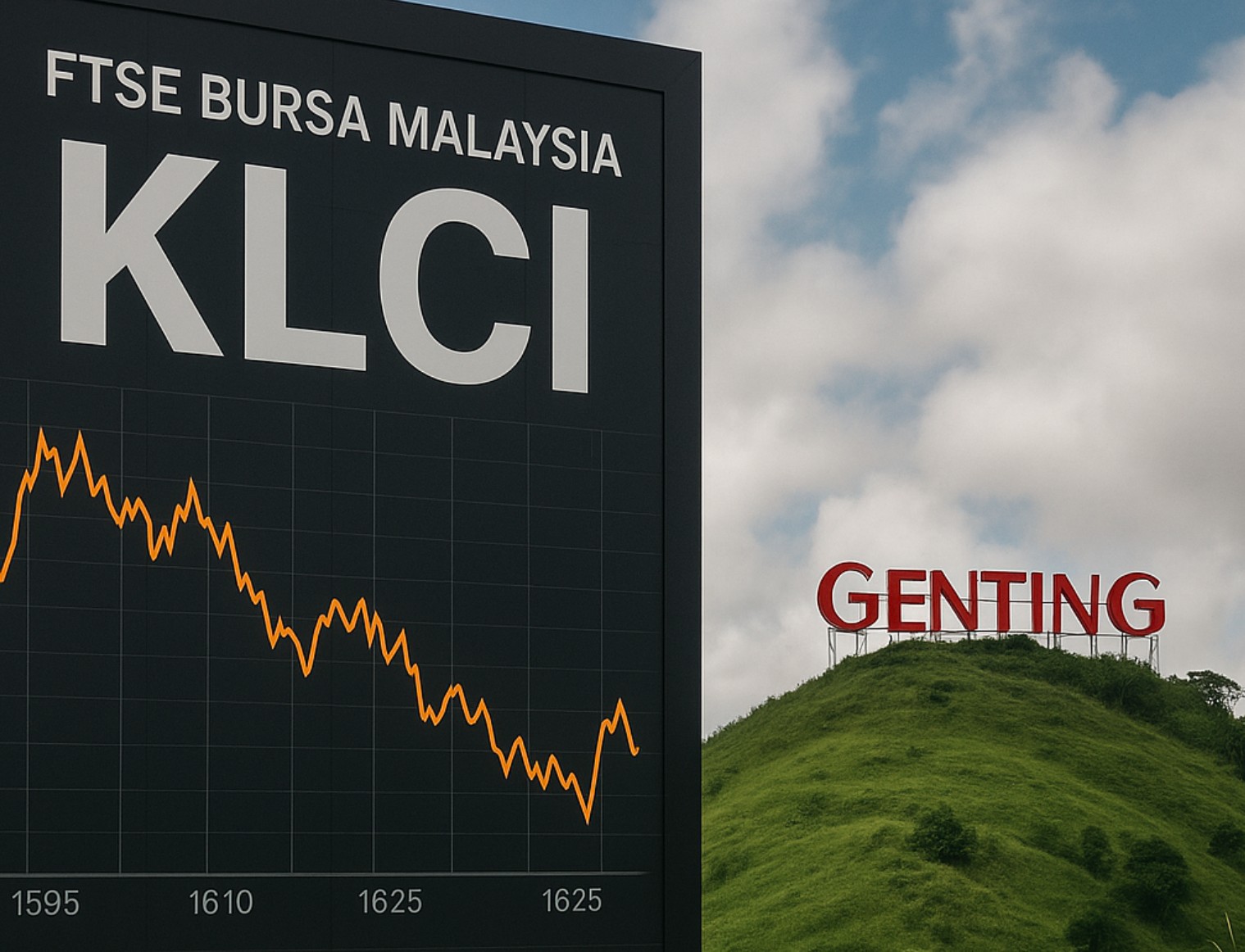
Market Overview: KLCI Slides Amid Regional Weakness
Bursa Malaysia closed lower on October 14, 2025, with the FBM KLCI dipping 3.73 points (–0.23%) to 1,611.46, marking its third consecutive session of decline. The broader market followed suit — FBM70 slipped 0.36%, FBMEMAS eased 0.34%, and FBMSHA fell 0.50%.
Trading activity remained moderate, with around 3.65 billion shares worth RM3.8 billion changing hands. The market initially opened on a positive note, tracking Wall Street’s rebound, but gains were erased by midday amid cautious sentiment across Asian markets.
Hong Kong’s Hang Seng Index dropped nearly 2%, while Shanghai’s composite retreated as investors digested ongoing U.S.–China trade tensions and regional geopolitical developments.
Top Gainers and Losers
- Genting Malaysia (GENM) surged RM0.18 to RM2.32 on heavy volume after confirmation of a takeover offer by its parent company, Genting Bhd.
- Genting Bhd itself advanced RM0.15 to RM3.01 as investors reacted positively to the restructuring move.
- Other notable gainers included Nestlé, F&N, and Malayan Cement, all benefiting from renewed domestic interest.
- Among the decliners were Malaysian Pacific Industries, Petronas Gas, and Petronas Dagangan, which saw mild profit-taking following recent gains.
Key Market Drivers
1. Genting’s RM6.74 Billion Takeover Bid
Genting Bhd launched a conditional voluntary cash offer of RM2.35 per share for all remaining shares of Genting Malaysia it does not already own. The deal, valued at approximately RM6.74 billion, represents a 9.8% premium over GENM’s pre-suspension price.
The move could lead to privatisation or delisting if Genting secures more than 90% of outstanding shares. GENM was the most actively traded stock of the day, drawing both institutional and retail participation.
Impact on KLCI: As a key index component, any privatisation of GENM could alter the KLCI’s composition and liquidity profile. The deal also sparked momentum across the gaming, hospitality, and tourism sectors.
2. Malaysia’s 2026 Budget & Fiscal Reforms
Malaysia’s newly tabled 2026 Budget outlined total spending of RM470 billion, a notable increase from the previous year. The government reaffirmed its focus on fiscal discipline, targeted subsidies, and structural tax reforms.
Key highlights include:
- Introduction of a carbon tax and higher excise duties on tobacco and alcohol.
- Implementation of nationwide e-invoicing to improve tax compliance.
- Gradual reduction of blanket subsidies, expected to save RM15.5 billion annually.
While these reforms are viewed as fiscally responsible, analysts noted potential short-term headwinds for energy and consumer sectors. However, the budget is broadly seen as supportive of domestic demand, infrastructure projects, and utilities.
Impact on KLCI: Positive for domestic-centric counters, though lower Petronas dividends projected for 2026 may tighten fiscal space and affect state-linked equities.
3. Shift in Investment Facilitation Policy
Reports surfaced suggesting that Malaysia may scale back certain pro-investment initiatives, previously designed to attract foreign direct investment. The government appears to be reassessing incentive schemes to balance fiscal responsibility with industrial competitiveness.
Impact: This shift could temporarily dampen momentum in semiconductor, manufacturing, and green-tech sectors, which rely heavily on investment incentives and multinational participation.
4. Regional and Global Developments
U.S. President Donald Trump’s announcement that he would not impose a 100% tariff on China helped global markets rebound earlier in the day. However, lingering trade uncertainty kept regional investors on edge.
Separately, ahead of the ASEAN Summit in Kuala Lumpur (Oct 26–28), Malaysia is gaining diplomatic visibility as ASEAN Chair, helping to broker a Thailand-Cambodia ceasefire deal. While not a direct market catalyst, improved regional stability could enhance foreign investor sentiment toward ASEAN equities.
5. Upcoming Market Holiday
Investors are reminded that Bursa Malaysia will be closed on October 20, 2025, in observance of the Deepavali holiday. Thin trading and defensive positioning are expected leading up to the break.
Key Risks Ahead
- Renewed U.S.–China tariff headlines could heighten market volatility.
- Execution risk in the Genting privatisation deal or regulatory delays.
- Potential margin pressure from carbon tax and excise hikes on energy and manufacturing firms.
- Reduced Petronas dividends may constrain fiscal flexibility.
- Possible slowdown in new FDI approvals if investment facilitation reforms persist.
Outlook
Analysts expect the KLCI to trade between 1,610–1,620 in the near term, with bargain hunting likely if the index approaches the 1,600 mark. Sentiment remains cautious, but selective opportunities exist in domestic consumption, utilities, and infrastructure plays.